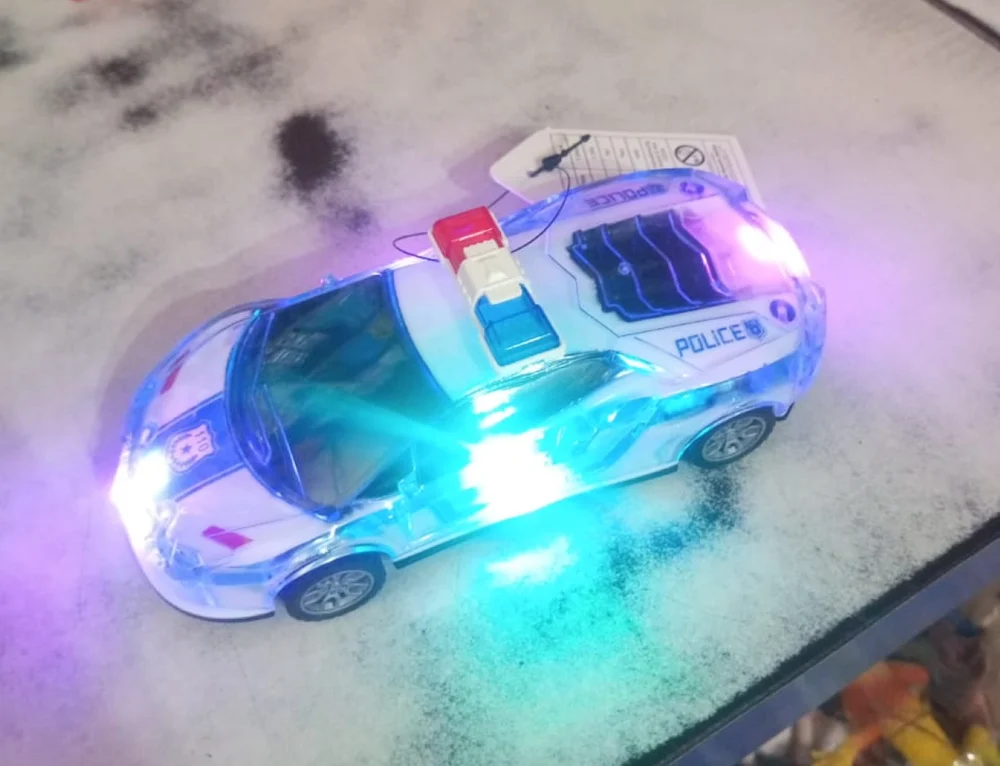
I remember getting the cop car and just lying on the floor watching it. The lights flashing, the car moving around, bumping into things, reversing, coming back. I’d follow it across the floor. And it sparked this need in me: how is this thing moving? I really wanted to understand how it moved. So I went looking around the house and found a butter knife, because that’s what I could find. I took the battery out first, then started working the Phillips screws loose with the knife. With the car wide open, I sat there investigating, trying to understand as much as I could. Which wire color meant what. Why they connected the way they did. Then my mom caught me. She was upset, the car was brand new, and she told me she’d never buy me toys again because all I knew how to do was destroy them. I put it back together slowly, every screw where it had been.
I grew up poor. While friends had a Mega Drive or a PlayStation, I had a cheap knockoff console, hundreds of games on it, none of them the real thing, a Super Mario under some other name. I wasn’t allowed on the main color TV, so I had to make do with an old black-and-white set. Getting a picture was the hard part. There was a thing in the back, not quite a knob, more like a recessed screw, and I’d turn it slowly hunting for the frequency where the image would hold still. Often it came through with no sound, so I’d go searching for another frequency that had sound even without a picture.
One day it wouldn’t turn on. So, curious as ever, I cut the power, unplugged it, and opened the shell. I was amazed at what was inside: little parts soldered together, that smell of old electronics. I tried a few things, closed it back up for safety, and hit the power to check. I couldn’t fix it, but I’m fairly sure I found the problem. After that, my mom let me connect the console to the color TV. The same games, now in color.
Looking back, I was just trying to understand how they worked. It felt like magic, magic in the real world. It amazed me that someone had thought up a way to make this thing move, light up, run on electricity. Sometimes I got things back together, every piece in place. Other times there’d be leftovers, a screw or two I never worked out where they belonged. But that was never really the point. The point was the understanding.
The instinct never left. As a teenager I had an old, underpowered computer, and I was always pushing it past what it should handle, squeezing out performance to keep up with friends who had better machines. Then one afternoon I came home and it wouldn’t turn on. I couldn’t work out why, so I spent the money I’d been saving for comics on a book about fixing computers. It helped me trace the problem to a dead power supply. I bought a cheap replacement, fitted it, and the machine came back to life. That was the hook. From there I started building my own.
The same drive shows up in how I design. When I build a product, I get excited about its bones, not just its surface: what it’s really for, how it’s organized, what makes it tick. I take apart something that already works, keep what matters, and build something new from it. Not copying. Incorporating, mutating, making.
The one thing that never changed is the curiosity. The kid on the floor with the butter knife and the designer I am now are the same person, asking the same question: how does this work, and what could I make from it? It has never really felt like work. More like a calling. I still get that feeling I had with the cop car, the quiet amazement that someone figured out how to make a thing run. I don’t think it will ever leave.